The silent language of the paw.
You are sitting on the couch, perhaps reading or scrolling through your phone, when you feel it, a gentle, insistent pressure on your arm, your leg, or your hand. You look down, and there it is. A single paw ...

There is a moment every dog owner recognizes immediately. You are sitting on the couch, perhaps reading or scrolling through your phone, when you feel it, a gentle, insistent pressure on your arm, your leg, or your hand. You look down, and there it is. A single paw, lifted and placed upon you with deliberate care. Maybe it is accompanied by a soft stare, a slight head tilt, or a small whine. Maybe it is silent. But it is never meaningless. Your dog has just spoken to you, not with a bark or a wag, but with the quiet, expressive language of their paw.
We spend so much time watching our dogs tails, ears, and mouths that we often overlook one of their most sophisticated communication tools. Those soft, padded feet are not just for digging holes or clicking across kitchen floors. They are finely tuned instruments of connection, capable of conveying everything from a simple request to a profound expression of love. Learning to listen with your eyes when your dog reaches out a paw is like being handed a translation key to their inner world.
The most common meaning behind the paw lift is also the most endearing. Your dog is asking for attention. In a world where they cannot use words, they have discovered a physical gesture that is nearly impossible to ignore. Think about the very first time your dog placed a paw on you. Perhaps you were sitting quietly, and you responded by petting them, speaking to them, or looking into their eyes. In that single moment, a powerful lesson was learned: paw equals response. Your dog is not being manipulative in a scheming, human sense. They are simply being brilliant communicators. They have found a button that works, and they will press it again and again. That paw on your knee while you are eating dinner is not rudeness. It is a hopeful, polite inquiry: “I see you have something. Might there be a tiny piece for me?”
But reducing the paw to a mere begging tool would be a grave misunderstanding of its emotional range. Dogs also use their paws to express empathy and concern. Anyone who has felt the heavy weight of sadness knows that dogs seem to sense it. You might be crying, sitting quietly with your head in your hands, and your dog will approach slowly, not with a wagging tail or a playful bounce, but with a solemn grace. They will sit beside you, and then, almost hesitantly, they will lift a paw and rest it on you. This gesture is different from the eager, attention-seeking paw. It is softer, heavier, and held for longer. In those moments, your dog is not asking for anything. They are offering something. They are saying, “I don’t know what is wrong, but I am here. You are not alone.” Ethologists who study canine behaviour have noted that this type of paw placement mimics the comforting touch that puppies receive from their mothers. It is an ancient, instinctive language of solace.
Then there is the paw of apology or appeasement. Dog owners are often puzzled when their dog, having been scolded for chewing a shoe or stealing food from the counter, approaches with a lowered head, ears back, and lifts a paw. Some owners interpret this as guilt, but animal behaviourists suggest it is something slightly different. It is a peace offering. The paw lift in this context is a calming signal, a way for your dog to say, “I see that you are upset. I am not a threat. Let us be friendly again.” It is their version of extending an olive branch. They have learned that this gesture often softens your expression and leads to reconciliation. It is not an admission of moral guilt, dogs do not experience shame the way humans do, but it is a deeply social intelligence at work, a desire to restore harmony in their pack.
In more active contexts, the paw becomes a tool of invitation. You have likely seen your dog slap a toy with their paw, or gently bat at your hand while you are holding a rope toy. This is the paw of play. It is an exclamation point on an invitation. A dog who wants to wrestle might place both paws on your chest. A dog who wants you to throw the ball might nudge it toward you with a paw. This playful pawing is often accompanied by the play bow, front legs stretched out, hindquarters in the air, which we discussed before. Together, these gestures form a complete sentence: “I am feeling joyful, and I want you to share this joy with me. Let us do something fun, right now.”
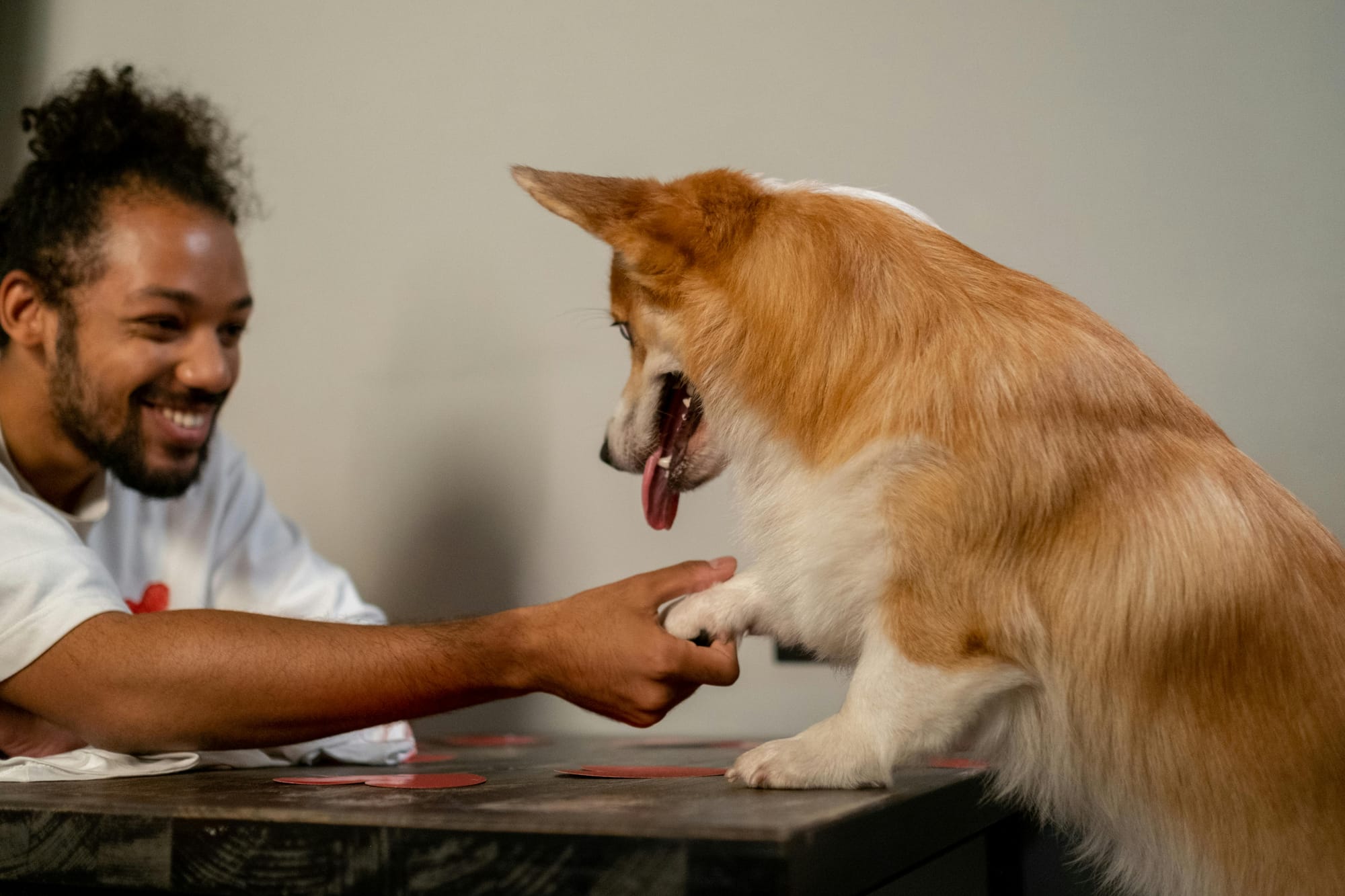
Perhaps the most sophisticated use of the paw, however, is what researchers call “referential communication.” This is a fancy term for a simple but astonishing ability. Your dog can use their paw to point something out to you. A dog who hears a strange noise outside might lift a paw and hold it frozen, ears swivelled toward the sound, looking back at you as if to say, “Did you hear that?” A hunting breed might freeze and lift one front paw, literally pointing toward a hidden squirrel or bird. This is not a trained behaviour for many dogs; it is instinctive. But when they do it and then glance at you, they are doing something remarkable. They are sharing their attention. They are inviting you to look at what they have found. That shared focus is a cornerstone of social intelligence, and it is one of the key reasons dogs are so exquisitely attuned to human life.
Of course, not every paw lift is a warm conversation. Sometimes, the paw speaks of discomfort or pain. A dog who repeatedly lifts the same paw while standing still, or who holds a paw up without putting it back down, may be trying to tell you something is wrong. A thorn, a cut pad, an arthritic joint, these physical pains often manifest as a lifted paw. The difference lies in the context. A happy, relaxed dog who places a paw on you during cuddle time is communicating affection or a gentle request. A dog who stands alone, holding a paw in the air, shifting weight away from it, is sending a distress signal. Learning to distinguish between the conversational paw and the painful paw is an essential skill for any caring owner.
What makes the paw so extraordinary as a communication tool is its versatility. It can be soft or insistent. It can be a fleeting touch or a heavy, prolonged rest. It can be paired with a hopeful gaze, a worried whine, or a playful bark. Your dog has no hands to gesture with, no fingers to point. And yet, they have adapted one of their four points of contact into a subtle, nuanced instrument of expression. They have learned that you respond to touch. They have learned that their paw, placed upon you, creates a bridge between your species.
When you think about it, the paw is a testament to the depth of your relationship. A dog who does not trust you will not willingly place a paw on you. That gesture requires vulnerability. It requires your dog to reach out, to make contact, to risk being ignored or pushed away. Every time your dog’s paw rests on you, it is a small act of faith. They believe you will respond. They believe you understand. And in that belief, they are almost always right.
The language of the paw is not a simple code to be cracked, but a beautiful conversation to be savoured. Your dog speaks to you constantly through this gentle gesture, and the meanings are as varied as the moments you share. They place a paw on you to ask for dinner, to offer comfort when you cry, to apologize after a mistake, to invite you to play, to point out a squirrel, and most of all, to simply stay connected. They have no thumbs, no spoken words, and no way to write you a letter. But they have their paw, and they have learned that when they reach out with it, you listen. So the next time you feel that familiar, soft pressure on your arm or leg, pause before you react. Do not simply assume they want a treat or a walk. Look into their eyes. Notice the quality of the touch. Is it eager? Is it gentle? Is it worried? Is it playful? Your dog is not just asking for something. They are sharing a piece of their inner world with you. And in that silent, furry, four-toed sentence, there is a profound truth: love does not always need words. Sometimes, it simply needs a paw.